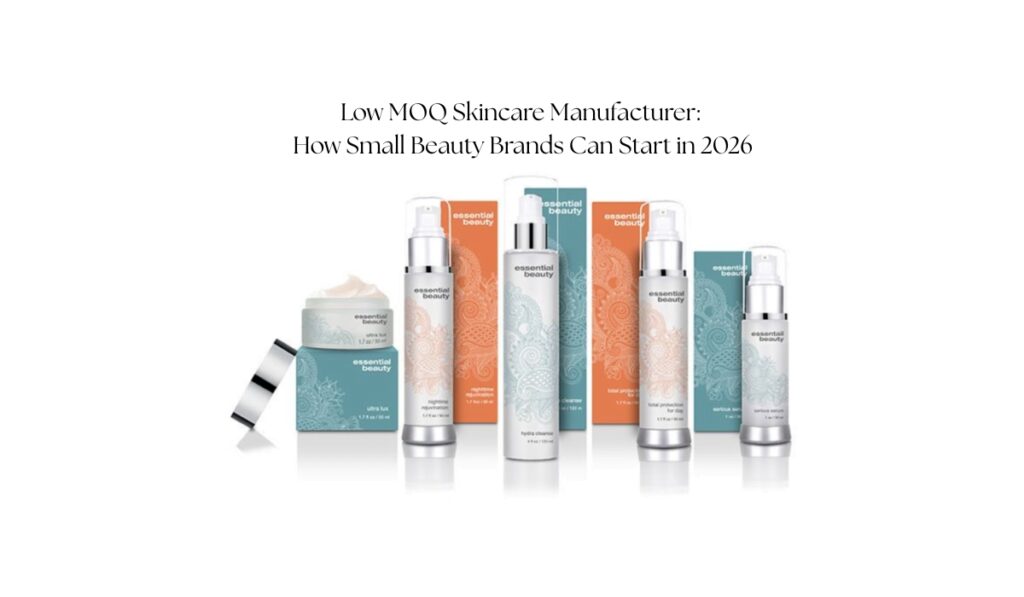
Launching a skincare brand no longer requires massive inventory investment. In 2026, many beauty startups are choosing low MOQ skincare manufacturers to test products, validate markets, and reduce financial risk before scaling production.
For emerging brands, finding a reliable low MOQ skincare manufacturer is often the key to entering the beauty market efficiently while maintaining flexibility.
However, low MOQ production also comes with important considerations related to formulation options, packaging selection, production cost, and scalability.
This guide explains how low MOQ skincare manufacturing works and how brands can choose the right production strategy for long-term growth.
1. What Does Low MOQ Mean in Skincare Manufacturing
MOQ stands for Minimum Order Quantity.
In skincare manufacturing, MOQ refers to the minimum number of units required for production.
Traditional factories often require large orders to optimize manufacturing efficiency. However, in 2026, many OEM and ODM skincare manufacturers now offer lower MOQ solutions to support startups and independent beauty brands.
Low MOQ production is especially popular for:
New skincare startups
Online beauty brands
Influencer skincare brands
Market testing projects
The ability to launch smaller batches helps brands reduce inventory pressure and test consumer response before expanding.
2. Benefits of Low MOQ Skincare Production
Low MOQ manufacturing offers several advantages for growing brands.
Key benefits include:
Lower upfront investment
Reduced inventory risk
Faster market testing
Greater product flexibility
Easier product line expansion
This production model allows brands to focus more on branding, marketing, and customer acquisition during early growth stages.
For brands planning product category strategy, you can explore popular skincare categories here:
3. Common Low MOQ Skincare Products
Not all skincare products are equally suitable for low MOQ production.
The most common low MOQ products include:
Facial serums
Creams and lotions
Facial cleansers
Body care products
Sheet masks
Products with simpler production processes and standardized packaging are usually easier to produce in smaller quantities.
Capsule skincare products and highly customized formulations may require higher MOQs due to specialized manufacturing processes.
You can explore our skincare product portfolio here:
4. Low MOQ and Private Label Manufacturing
Private label skincare manufacturing is one of the most common low MOQ solutions.
In private label production, manufacturers provide ready-made formulations that brands customize with their own logo and packaging.
This approach offers:
Shorter development time
Lower R&D costs
Faster market entry
Simplified production process
Many successful skincare startups begin with private label products before transitioning into more customized OEM or ODM development.
For a deeper understanding of manufacturing models, you can refer to this guide:
Private Label Skincare vs OEM vs ODM Explained 2026
5. How Low MOQ Affects Production Cost
Although low MOQ production reduces initial investment, the unit cost per product is usually higher compared to large-scale manufacturing.
This is because:
Raw material purchasing efficiency decreases
Packaging sourcing costs increase
Production setup costs are distributed across fewer units
Brands should balance flexibility and long-term profitability when planning low MOQ production strategies.
For more detailed cost analysis, you can refer to this article:
How Much Does It Cost to Manufacture Skincare Products in 2026?
6. Packaging Considerations for Low MOQ Orders
Packaging is one of the biggest factors affecting low MOQ feasibility.
Custom molds and highly specialized packaging often require large order quantities. As a result, many low MOQ brands initially choose:
Standard bottles
Stock packaging
Simple label systems
Minimalist packaging designs
This approach helps reduce development complexity and accelerate product launch timelines.
For insights into current packaging strategies, you can explore this guide:
Skincare Packaging Trends 2026: How Packaging Affects Brand Success
7. Choosing the Right Low MOQ Manufacturer
A professional low MOQ skincare manufacturer should provide:
Flexible production capability
Stable formulation systems
Fast communication
Packaging support
Scalable production planning
Brands should also verify whether the manufacturer has real factory facilities, quality control systems, and international export experience.
At Opseve, we provide OEM/ODM skincare manufacturing solutions with flexible production support for both startups and growing beauty brands.
Learn more about our manufacturing capabilities here:
8. Planning for Future Scaling
Low MOQ production should not only focus on short-term launch goals. Brands should also evaluate whether the manufacturer can support future expansion.
As sales increase, brands may require:
Larger production volumes
More customized formulations
Advanced packaging solutions
Expanded product categories
Working with a scalable skincare manufacturer helps ensure smoother long-term growth and operational stability.
Conclusion
Low MOQ skincare manufacturing gives beauty brands greater flexibility and lower entry barriers in 2026.
By choosing the right manufacturing strategy, startups can reduce risk, validate product demand, and build strong foundations for future growth.
A reliable skincare manufacturer not only supports small-batch production but also helps brands scale efficiently as market demand increases.